Snapshot
We Take Them Where We Can Get Them

In the Beginning…
If you came to this Substack from the Still Ruthanne website, much of this post will be familiar to you. Hang with me, and I promise all posts going forward will be new. I just want everyone to be moving forward from the same place.
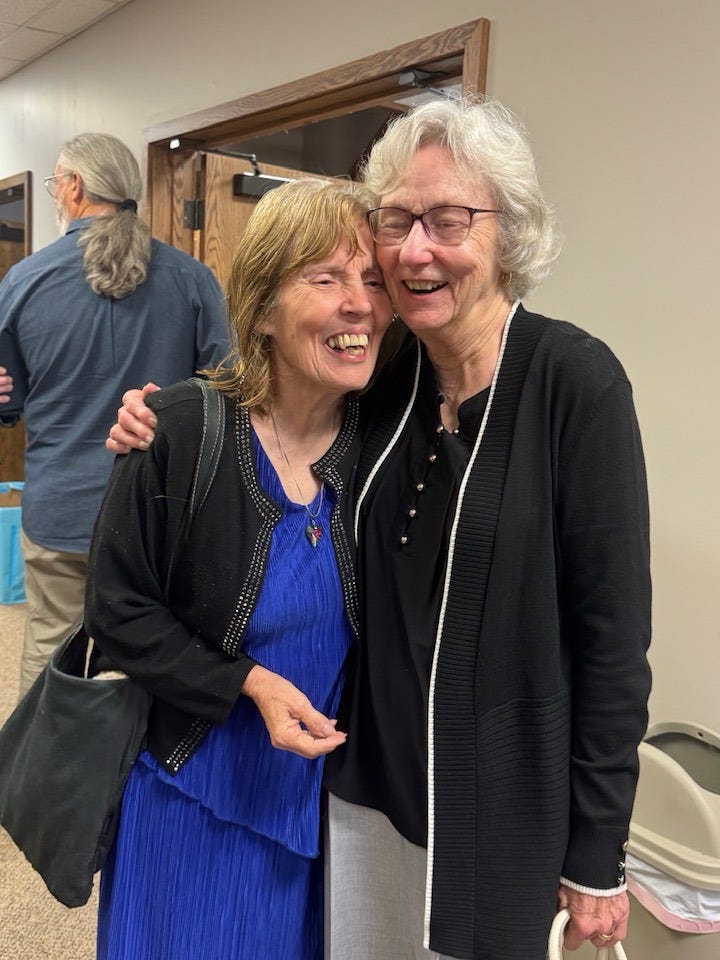
For those of you who came here from a direct link or found us through the Substack universe, here’s a little background on the photo above. It was taken on a Friday afternoon, when Mom’s dear friend Ruby (on the left) and I took Mom to lunch at a nearby steakhouse. As we got out of the car, Mom looked up at the sky and stopped short, enthralled by the bright blue of the summer sky and the brilliance of the clouds.
“Look!” she cried. “Can you see them? They’re all up there.”
“They” are our loved ones, and she sees them often, looking down at us and smiling. She doesn’t understand why they can’t come down from Heaven—“That just doesn’t make sense,” she says—but she’s always excited to see them.
It was such a moment of unadulterated joy that, as Ruby and I both moved in to hug her, I had to take a photo.
This is Mom the way I want to remember her.
This joy is what I want for her.
But Mom has dementia (all indicators point to Alzheimer’s with Lewy bodies, which I’ll get into in later posts), and as anyone who’s gone this road with a loved one knows, you have to take these moments when you can. Because dementia is a thief—of memory, of self, of happiness. You watch your loved one struggle with fear, anxiety, and sometimes anger as they navigate a strange and frightening world that no longer follows the rules of time and space. Little by little, the person you loved disappears, and each new loss is another grief.
There’s a reason dementia is called The Long Goodbye.
Two months ago, a dementia expert evaluated Mom with the Global Deterioration Scale (can you imagine a more demoralizing name?). This assessment divides each of the seven stages of dementia into decimals, Mom scored at 5.6: moderately severe cognitive decline. Advanced cognitive decline is 5.8.
“We can’t predict anything with certainty, he cautioned, “but Lewy bodies accelerate the progression of the disease.” Based on his experience, he guessed it would take about twelve months for Mom to reach 6.6.
We’ll talk about what that means another time, but still…twelve months. A single year. My brother and I sometimes look up the projected timelines for each stage of the decline. Life expectancy. Cognition checklists. It’s a long road, but we first noticed the signs in 2018, so we’re seven years down it.
My guess is Mom’s progression will follow an atypical trajectory. That her language will be more disordered, her perceptions less tethered to reality, with her physical abilities at a much higher level than her cognition. (“No one can ever stand on the balance pillow AND do the three-pound weights!” the physical therapist once marveled, as she she did indeed do both those things. Still, as the occupational therapist said a few days later, “She has a complicated neurological profile.”)
There is so much Mom has forgotten--the names of her husbands, that we lived in Canada the summer I was seven, the Elvis concert she took me to see shortly before he died--and yet, she still loves cats and sparkles and beautiful things. She loves to rumba and push-pull swing. She loves to sing her favorite hymns, her high, clear voice rising for the parts she remembers and dropping to a soft approximation when she forgets the words. We sing “You Are My Sunshine” to each other, and “Somewhere Over the Rainbow,” and her favorite snippet from “Anything You Can Do, I Can Do Better,” from Annie Get Your Gun. She still hates strawberries and pinto beans, and she still loves mashed potatoes and gravy (and pancakes, and ice cream!).
She is still Ruthanne.
However cruel this disease might be, I think—somewhere inside her—she always will be. What my brother and I want, more than anything, is to give her as many of those joyful moments as we can, for as long as we can.
Why this, why now?
If you don’t know Mom but are on this path with a loved one of your own, I hope you’ll find some comfort and maybe some insights from what I’ve learned (and am learning) about this heartwarming, heartwrenching journey through my mother’s dementia. I hope you’ll share your experiences here as well. We’re on a tough road. Maybe we can help each other along it.
If you do know Mom, you know how she shines. How many people she brought into her home when they had nowhere else to stay. How well and how long she served her church. How she could walk into a room and make it brighter just by being there. If she had one dime and you needed it, it was yours.
I’ve been hearing from a lot of you lately. “How’s Ruthanne doing?” they ask, and “Is there anything we can do to help?”
This Substack is my attempt to answer these questions. If you’re one of the many people who knew and loved Mom, I hope you’ll enjoy these weekly updates on her current condition and our weekly “adventures,” along with some stories from her life you might never have heard. I hope you’ll share some of your memories of her too. (I just learned a new story about her today—which is a tale for another time.)
And yes, you can help. You help with your calls, with your support, with your kindness. By going to lunch with us, visiting her, and cooing over her “baby”—that little stuffed monkey who has become my littlest brother. And you can help through your subscription to this newsletter.
But Beth, how does a subscription help?
There are three subscription tiers. The content is the same for all three, and the first one will always be free, because keeping her memory alive in the minds and hearts of the people she loves is at the top of the priority ladder. Sharing her story with others who are going through this with their loved ones is almost as important.
But because the loving, high-quality memory care facility she’s in is very expensive, and because some of you have asked how you can help us make it possible for her to stay there, the other two are paid subscriptions.
Whichever tier you choose, free or paid, we’re grateful for you. Thank you for caring about Mom.
Mom, with her friend Joan, from church.